07/24/2026
Hip pain isn’t just something that affects older adults with arthritis. For many younger, active people, persistent groin pain, pinching or catching in the hip may be the result of a treatable structural problem. In this video, Dr. Charles Burt explains the common causes of non-arthritic hip pain, the role of hip impingement and labral tears, and when it’s time to seek an evaluation — as well as who can benefit from hip arthroscopy.
Video transcript
Dr. Charles Burt:
My name is Charlie Burt, I’m an orthopedic surgeon at OrthoNebraska, and my primary focus in my practice is hip arthroscopy.
I’ve been in practice since 1998 and have done several thousand hip arthroscopies.
Hip pain in younger people with non-arthritic conditions is a fairly unique thing, and something that many orthopedists don’t deal with, so it has a unique set of symptoms compared with arthritic hip pain.
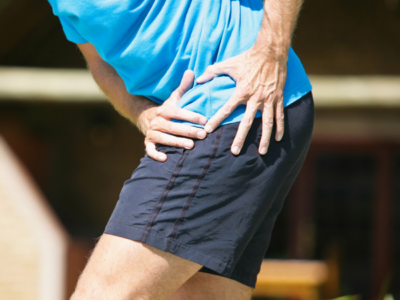
Some of the most common symptoms of hip pain in younger people are: a sense of pinching in the groin, difficulty sitting for long periods of time, and oftentimes a sense of catching when you rotate your hip in different ways.
[Many people also experience pain] when putting on their shoes and socks or rotating their hip during everyday movements.
What Causes Non-Arthritic Hip Pain?
Most non-arthritic hip pain is caused by damage to the soft tissues around the hip, and primarily that’s the labrum.
The labrum is a fibrocartilaginous, or rubbery, structure that goes around the rim of the hip socket. Its function is to deepen the socket, stabilize the hip, and to help provide a suction seal that allows the fluid in the hip joint to remain pressurized and decrease friction.
Most people who damage their labrum do that over a long period of time. It’s often caused by the ball and socket not fitting together quite right, and that’s called hip impingement.
Types of Hip Impingement
There are two primary types of hip impingement.
One is called pincer impingement, where the hip socket is too deep or incorrectly rotated. There’s not enough space between the ball and the socket, and the ball rubs against the edge of the socket and damages the labrum where it attaches.
The other primary type of impingement is called cam impingement. This occurs when the ball of the ball-and-socket joint is not perfectly spherical. As it flexes into the hip socket, it places abnormal pressure on the edge of the socket and the labrum, which can damage both the labrum and sometimes the cartilage that lines the socket, as well.
A lot of the people we care for actually have combined impingement, where the hip socket is somewhat too deep and the ball is slightly out of round. This creates a kind of double-crush phenomenon where the labrum and cartilage are being compressed on both sides.
For people who have ongoing groin pain, a persistent groin pull, or sharp pain deep in the groin or on the lateral aspect of the hip, anything that lasts for more than a couple of months or continues to worsen may indicate a structural problem.
I would say at that point, it’s a good idea to be evaluated by an orthopedic surgeon. We can assess your hip with a physical exam and X-rays to determine whether your symptoms suggest structural damage.
We do know that once people have structural damage to their hip, especially significant hip impingement or femoroacetabular impingement (FAI), the longer that damage is left alone, the more challenging it becomes to fully repair and return people to a pain-free state.
Treatment Options
Although physical therapy and other conservative treatments can help some people who have small labral tears, mild impingement, or mild impingement without a labral tear, in general, if you have a significant labral tear or significant impingement, surgery is often the best treatment. That consists of repairing the labrum and correcting the bony impingement of the ball-and-socket joint.
In general, we would expect somewhere between 85% and 90% of patients who have this surgery to have a successful outcome. That would mean complete or near-complete resolution of their symptoms with no further need for surgery.
Returning to Daily Life and Sports
Some of the people we care for have chronic, ongoing daily pain that affects their everyday activities. But a significant portion of the people we take care of are having pain more from athletic activities.
Our goal is the same for everyone: to eliminate their pain. But especially for athletes — whether recreational or competitive — our goal is to get them back, pain-free, doing the sports they enjoy.