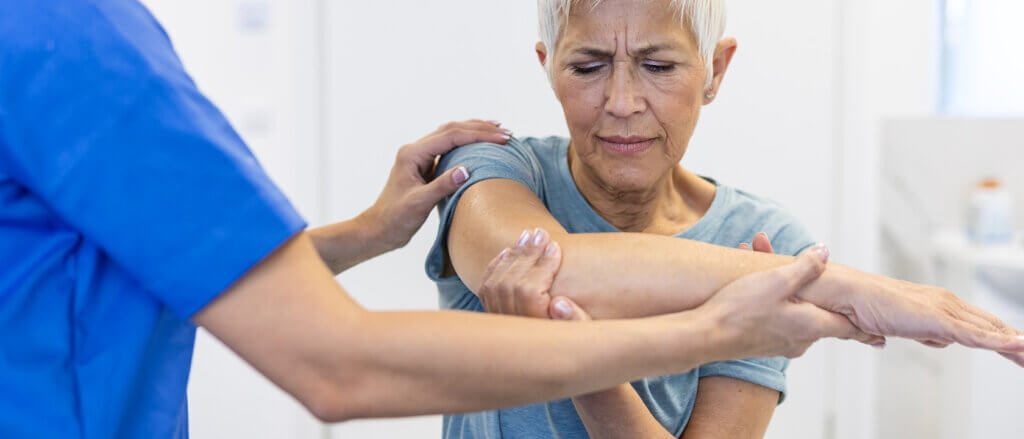
Fractured or Dislocated Elbow

Elbow fractures and dislocations are serious injuries that can significantly affect arm movement and daily function if not treated properly.
Most often caused by traumatic events such as falls or direct impact, these elbow injuries range from small cracks in the bone to complex fractures and complete joint dislocations.
What Is a Dislocated or Fractured Elbow?
The elbow is a complex hinge joint made up of three bones — the humerus, radius and ulna — along with multiple ligaments, muscles and nerves that allow bending, straightening and rotation of the forearm. Fractures occur when one or more of these bones break, while dislocations happen when the bones are forced out of normal alignment.
Elbow fractures and dislocations can occur independently or together and are most commonly the result of traumatic injury. They are seen more frequently in women and adults between the ages of 30 and 40, though they can occur at any age.
What are the Causes of Dislocated and Broken Elbows?
Elbow fractures and dislocations most commonly result from:
- Falls onto an outstretched hand or directly onto the elbow
- Direct blows to the elbow
- Twisting injuries to the arm
- Sports injuries or motor vehicle accidents
Sprains, strains, ligament tears or joint dislocations may occur at the same time as a fracture, particularly in higher-energy injuries.
What are the Types of Elbow Fractures?
The location of the fracture plays a key role in determining treatment and recovery.
Radial Head and Neck Fractures
The radial head and neck are located near the elbow joint. These fractures are the most common type of elbow fracture and typically cause pain on the outside of the elbow, especially with twisting motions.
Distal Humerus Fractures
These fractures occur at the lower end of the humerus and involve the elbow joint surface. Distal humerus fractures are often complex and typically require surgery.
Olecranon Fractures
The olecranon is the bony tip of the elbow and serves as the attachment point for the triceps tendon. Fractures here are often displaced due to the pull of the tendon and frequently involve the joint surface. Most olecranon fractures require surgery.
In severe cases, olecranon fractures may occur alongside radial head fractures and ligament injuries, a combination sometimes referred to as a “terrible triad” injury, which typically requires surgical reconstruction of the joint.
How is a Broken or Dislocated Elbow Treated?
Treatment depends on the type of injury, degree of displacement, joint stability, and the patient’s age and activity level.
Nonsurgical Treatment
Fractures that are stable and minimally displaced may be treated without surgery and may include:
- Splint, sling or brace for support and protection
- Pain and anti-inflammatory medications
The elbow joint benefits from early movement in appropriate cases, even while the bone is healing, to help preserve range of motion.
Surgical Treatment
Surgery may be recommended when fractures are displaced, unstable or involve the joint surface, or when the elbow is dislocated. Surgical treatment may include:
- Realignment of bones using plates, screws, pins or wires
- Repair or reconstruction of injured ligaments
- Radial head replacement in severe fractures
- Urgent surgery for open fractures to reduce infection risk
Treat a Dislocated and Fractured Elbow at OrthoNebraska
Need relief from a fractured or dislocated elbow in the Omaha area? At OrthoNebraska, we want to make sure that our patients feel understood, safe and confident to take on an appropriate treatment plan. With proper management, we can help you reduce pain levels and improve quality of life.
Fractured or Dislocated Elbow Specialists
-
 Nicholas B. Bruggeman, MDHand & Wrist, Elbow, Sports Medicine
 -
 Michael J. Coffey, MDHand & Wrist, Elbow, Sports Medicine
 -
 Thomas P. Ferlic, MDElbow, Hand & Wrist
 -
 Todd J. Gaddie, MDHand & Wrist, Elbow, Sports Medicine
 -
 Alex C. Lesiak, MDHand & Wrist, Elbow, Sports Medicine
 -
 Andrew D. Nahr, MDShoulder, Elbow, Joint Replacement & Sports Medicine
 -
 Scott B. Reynolds, MDSports Medicine, Knee, Shoulder, Elbow
 -
 M. Andrew Thompson, MDElbow, Hand & Wrist, Shoulder, Sports Medicine
 -
 Matthew K. Tingle, MDSports Medicine, Shoulder, Knee, Elbow