Hip Strains

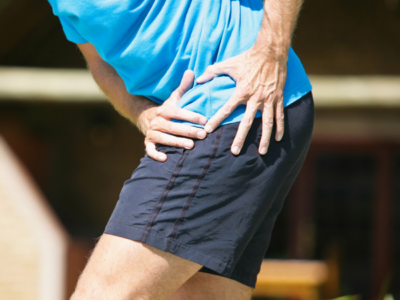
Hip strains are common during sports, exercise or sudden movements, but they can also occur during everyday activities.
A hip strain happens when one of the muscles surrounding the hip joint is stretched beyond its limit or partially/fully torn. Strains can be mild, moderate or severe, and the severity of the injury influences the level of limitations.
What Happens in a Hip Strain?
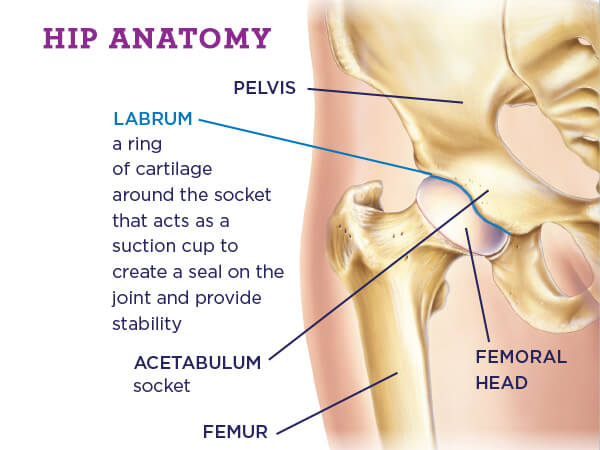
The hip joint is formed by the femur (thighbone) and the pelvis, which serve as anchors for several muscles. Muscles in the hip include:
- Hip flexors and lower abdominal muscles – help lift the leg and stabilize the pelvis
- Gluteals – support hip extension and rotation
- Adductors, quadriceps, hamstrings and tensor fasciae latae – control thigh and leg movement
Tendons connect these muscles to bone. Hip strains often occur near the tendon insertion point. Repeated strains in the hip and pelvis may lead to conditions such as a sports hernia.
What Causes Hip Strains?
Hip strains can result from:
- Acute injuries – sudden falls, stretching beyond limits, or direct impact during contact sports
- Overuse injuries – repetitive movements over time causing irritation or small tears
Risk factors include prior hip or groin injuries, muscle tightness or imbalance, insufficient warm-up before exercise, a sudden increase in intensity or duration of activity, and fatigue or deconditioning.
What are Hip Strain Symptoms?
Hip strain symptoms vary depending on severity:
- Pain or tenderness in the hip or groin
- Swelling or bruising
- Weakness in the hip muscles
- Limited range of motion
- Pain during activity, especially twisting, bending or lifting the leg
Severe strains may prevent normal hip movement and require medical evaluation.
How Are Hip Strains Treated?
Nonsurgical Treatment for Hip Strains
Most hip strains improve without surgery by following these guidelines:
- Rest – avoid activities that worsen pain for the first few days
- Ice – apply cold packs for 15–20 minutes multiple times per day to reduce swelling
- Compression – use soft wraps or compression shorts to limit swelling
- Heat therapy – after 72 hours, alternating heat and ice can improve pain and flexibility
- NSAIDs – such as ibuprofen or naproxen to relieve pain and inflammation
- Home exercise program – stretching and strengthening exercises prescribed by your doctor
- Physical therapy – if pain persists, a physical therapist can develop a tailored program to restore strength, flexibility and endurance
Hip Strain Surgery
Surgery is rarely necessary for a hip strain. It is reserved for severe injuries, like if the muscle or tendon has completely detached from the bone and needs to be reattached.
What is Recovery from Hip Strains Like?
Mild to moderate strains typically heal in 10–14 days with rest and home care. Severe strains may take longer and require gradual return to activity.
Resume exercise only when strength and flexibility have returned and pain-free movement is possible.
How Can I Prevent Hip Strains?
Preventive strategies include:
- Regular strength and conditioning exercises
- Proper warm-up before sports or activity
- Using appropriate protective equipment
- Cooling down and stretching slowly after activity
- Gradually increasing exercise intensity
- Allowing adequate time for healing before returning to high-intensity activity
When to See a Doctor About a Hip Strain?
Seek medical attention if:
- Pain persists despite home care
- Hip movement is severely limited
- Swelling or bruising is extensive
- There is a suspected tendon avulsion or severe tear
Early evaluation ensures proper treatment and prevents further injury. Not sure if you need medical assistance? Take our pain assessment for a better picture.
Treat Hip Strains at OrthoNebraska
Need relief from a strained hip in the Omaha area? At OrthoNebraska, we want to make sure that our patients feel understood, safe and confident to take on an appropriate treatment plan. With proper management, we can help you reduce pain levels and improve quality of life.
Hip Strain Specialists
-
 Neil W. Antonson, MDHip and Knee Replacement
 -
 Charles F. Burt, MDHip Preservation and Arthroscopy, Sports Medicine
 -
 Mark E. Goebel, MDHip, Joint Replacement, Knee, Shoulder, Sports Medicine
 -
 Jace J. Heiden, MDSports Medicine, Knee, Shoulder, Hip Arthroscopy
 -
 Paul A. Watson, MDHip Arthroscopy, Sports Medicine, Joint Replacement
Related to Hip Strains
The hip joint is comprised of the femur (thighbone) and acetabulum (hip bone), which are joined by the labrum (tissue rim that seals the hip joint) and ligaments lining the hip capsule in order to maintain its secure and stable nature.